US-ROK Relations Beyond 2020
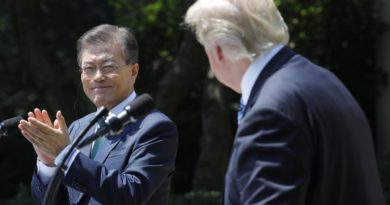
US-ROK relations have hit the lowest point since the Roh Administration, which is understandable considering the current ROK president was Roh’s chief of staff. Also, President Trump has taken a transactional approach towards this alliance “forged in blood” and pushed for the South Koreans to increase their burden under the Special Measures Agreement by over five-fold. In addition to calls for greater security spending by US allies, Trump has been critical of trade with allies resulting in the South Koreans abandoning developing nation status with the WTO. While increased cost sharing and the opening of agricultural sectors are beneficial to US interests, the manner in which these items are being negotiated are reason for concern in the health of the USROK alliance over the long-term.
US-Japan-ROK Security Relationship
President Moon has presided over disastrous economic policies juxtaposed with corruption scandals that have consistently lowered his approval rating to the recent level of 39%. And despite cabinet shuffles in an attempt to keep support up for his ruling Minjoo Party ahead of next year’s legislative elections, polling data shows that the gap between the Minjoo and Liberty Korea Parties is narrowing. Thus, Moon has turned to the time-tested tradition of inflaming nationalist sentiments in the ROK against Japan and announced the decision to end GSOMIA later this month. This has only served to anger the Americans and the Japanese, and done little to shore up the support his party so desperately needs.
Prime Minister Abe, on the other hand, has enjoyed approval ratings over 50% as the economy has continued to experience modest growth. However, Abe’s approval rating dipped slightly with a recent increase to the national consumption tax, and uncertainty over trade is increasing fears that a recession may be looming. Overall, this places Abe in a much stronger position vs-a-vi Moon to weather the impacts of the Japan-ROK trade/security spat. Moreover, Abe has maintained a smoother relationship with Trump than his South Korean counterpart and the US largely views this recent snag in the relationship as the fault of the ROK.
President Trump has had approval ratings remain relatively steady at around 40%, though he has experienced intense criticisms both within and surrounding his administration. Notwithstanding the recent impeachment proceedings, a majority of voters expect Trump to win re-election next year and continue his policies for another four years. While US efforts on the international arena may drawback next year in the run-up to the election, we should see more of Trump’s “America First” policy prescriptions post-2020.
Four More Years of Trump
President Trump has attempted to make clear that confronting the PRC is his number one priority in the Indo-Pacific, yet he has confusingly remained ambivalent towards US interests in the region. The US sent a non-cabinet level official to attend the ASEAN summit and when ASEAN members followed suit, the US response was to criticize the “embarrassment” of Trump. Meanwhile, the PRC is positioning itself to fill the gaps in US engagement with the region and, indeed, with the broader international system as evidenced by Xi’s globalization speech at Davos. The PRC has also offered to mediate between Japan and the ROK, to work with the ROK towards “denuclearization of the Korean Peninsula,” and has made strides in reshaping multilateral institutions using its own institutions as leverage. For all of Trump’s rhetoric, it seems his administration is but a continuation of Obama’s “managed decline” foreign policy that will only benefit the PRC and the DPRK in Northeast Asian geopolitics.
While President Moon has not explicitly called for the withdrawal of US troops from the Korean Peninsula, he does come from a political lineage that views US troop presence with some hostility. Like Roh before him, he understands the need for US buy-in to pursue friendlier — or, pro-DPRK — inter-Korean relations. And Trump’s ambivalence towards US allies in the region and his consistent calls for the ROK to dramatically increase its burden of cost-sharing may provide the cover he needs to begin explicitly supporting the removal of US troops. The ruling party’s celebration of the founding of the PRC hints at which side of the US-PRC divide Moon would like to tie his country too.
Further evidence for the disintegration of US-ROK relations over the long-term is the South Korean people’s views on Japan. In a hypothetical situation where the DPRK and Japan were to go to war, 45.5% of South Korean respondents claimed they would support the DPRK. Only 15.1% responded they would help Japan, with 39.4% having no idea. And while South Koreans still approve of the US-ROK relationship, 96% of respondents in a new poll do not want to increase their country’s current share of the costs under the current SMA. Trump’s “engagement” with KJU, willingness to overlook UNSC violations in missile launches, firing of John Bolton for his unwillingness to overlook those violations, and cancelling of joint exercises does not bode well for the future of US-ROK relations.